
Spandex fibres are synthetic elastic fibres made primarily from segmented polyurethane. They are valued for their ability to stretch several times beyond their original length and recover when the force is removed. In clothing, spandex is normally blended with nylon, polyester, cotton, or other base fibres rather than used alone.
For sportswear brands, the percentage of spandex is only one part of fabric selection. The base fibre, knit construction, fabric weight, finishing process, and recovery performance all influence how a garment feels and performs. A high-spandex fabric is not automatically softer, more breathable, or more durable.
Consider two products that both use an 80% nylon and 20% spandex fabric. A yoga legging may need soft four-way stretch and reliable squat-proof coverage, while a compression short may need firmer resistance and faster recovery. The fibre label can be identical, but the required wearer experience is different.
This guide explains what spandex fibres are made of, how they are produced, how they work, and how to evaluate spandex-blend fabrics for real activewear scenarios.
What Are Spandex Fibres?
Spandex is a manufactured elastic fibre. Under the U.S. textile fibre definition, its fibre-forming substance is a long-chain synthetic polymer made of at least 85% segmented polyurethane.
The spelling varies by market:
- Spandex is the common generic name in the United States and Canada.
- Elastane is widely used in Europe and on international fibre-content labels.
- LYCRA is a brand name, not the generic name for every spandex fibre.
- Fiber is the standard U.S. spelling, while fibre is common in British and international English.
These terms may appear differently on labels and technical documents, but spandex and elastane refer to the same general class of elastic synthetic fibre.
What Is Spandex Made Of?
Spandex is made from a segmented polyurethane-based polymer. Its structure contains alternating soft and hard segments, and each plays a different role.
- Soft segments can uncoil and extend when the fibre is pulled.
- Hard segments act as physical anchor points that help the fibre return toward its original shape.
Typical raw-material groups include:
- A macroglycol or polyol, which forms the flexible portion of the polymer.
- A diisocyanate, commonly used to react with the macroglycol and create a prepolymer.
- A chain extender, such as a diamine or diol, which builds the final segmented polymer structure.
- Process additives and finishes, which support spinning, handling, stability, and later textile processing.
This is why spandex behaves differently from ordinary rigid polyurethane products. Its polymer architecture is engineered specifically for extension and recovery.
How Is Spandex Produced?
Spandex fibre production generally combines polymer chemistry with a fibre-spinning process. Exact formulations and equipment vary by producer, but the main stages are similar.
1. Prepolymer formation
A macroglycol reacts with a diisocyanate to form a prepolymer. Careful control of the reaction affects the balance between flexibility, strength, and process stability.
2. Chain extension
The prepolymer reacts with a chain extender. This creates the segmented polyurethane or polyurethane-polyurea structure responsible for spandex elasticity.
3. Polymer solution preparation
For solution spinning, the polymer is dissolved in a suitable solvent to create a controlled spinning solution. The solution is blended and filtered before extrusion.
4. Spinning through a spinneret
The polymer solution passes through very small holes in a spinneret. These openings form fine continuous filaments.
5. Solidification and filament formation
In the commonly used dry-spinning process, heated gas removes the solvent as the filaments travel through the spinning cell. The solidified filaments can then be combined into multifilament yarn.
6. Finishing and winding
A finish may be applied to reduce friction and improve yarn handling. The yarn is then wound onto packages for further processing, covering, knitting, weaving, or blending with other fibres.
Spandex producers may use dry spinning, wet spinning, reaction spinning, or melt spinning, but dry spinning has historically been the dominant commercial route.
Why Do Spandex Fibres Stretch?
The stretch of spandex comes from the relationship between its soft and hard polymer segments.
When force is applied, the flexible soft segments become more extended and aligned. The hard segments help keep the molecular network connected. When the force is released, the soft segments return toward a more relaxed arrangement, pulling the fibre back toward its previous length.
This combination provides two important functions:
- Elongation, which allows the fibre to extend.
- Elastic recovery, which helps it return instead of remaining permanently stretched.
For apparel, recovery is often more important than maximum stretch. A fabric that stretches easily but does not recover well may bag at the knees, sag at the waistband, or lose compression after repeated wear.
Key Properties of Spandex Fibres
| Property | What it means for apparel |
|---|---|
| High extensibility | Supports close-fitting garments and freedom of movement |
| Elastic recovery | Helps waistbands, leggings, and fitted panels retain shape |
| Low required blend percentage | A relatively small amount can noticeably change fabric stretch |
| Lightweight fibre | Adds elasticity without needing a heavy rubber component |
| Low moisture absorption | Does not create moisture management by itself |
| Heat sensitivity | Excessive processing or care temperatures can reduce performance |
| Sensitivity to harsh exposure | Chlorine, UV exposure, and repeated high heat may shorten service life |
Spandex should not be treated as the source of every performance claim. Breathability, moisture transport, softness, cooling, abrasion resistance, and drying speed depend heavily on the base fibre, yarn structure, knit construction, fabric weight, and finish.
Is Spandex a Fibre or a Fabric?
Spandex is a fibre, not a complete fabric construction.
A fabric labelled 80% nylon and 20% spandex, for example, uses nylon as the main fibre and spandex to add stretch and recovery. Two fabrics with the same fibre percentages can still perform differently because of differences in yarn size, knit structure, density, finishing, and heat setting.
This distinction matters when sourcing activewear. Choosing a composition on paper is not enough. Brands should evaluate the actual fabric and finished garment under realistic movement, wash, opacity, and recovery conditions.
Common Spandex Blends in Sportswear
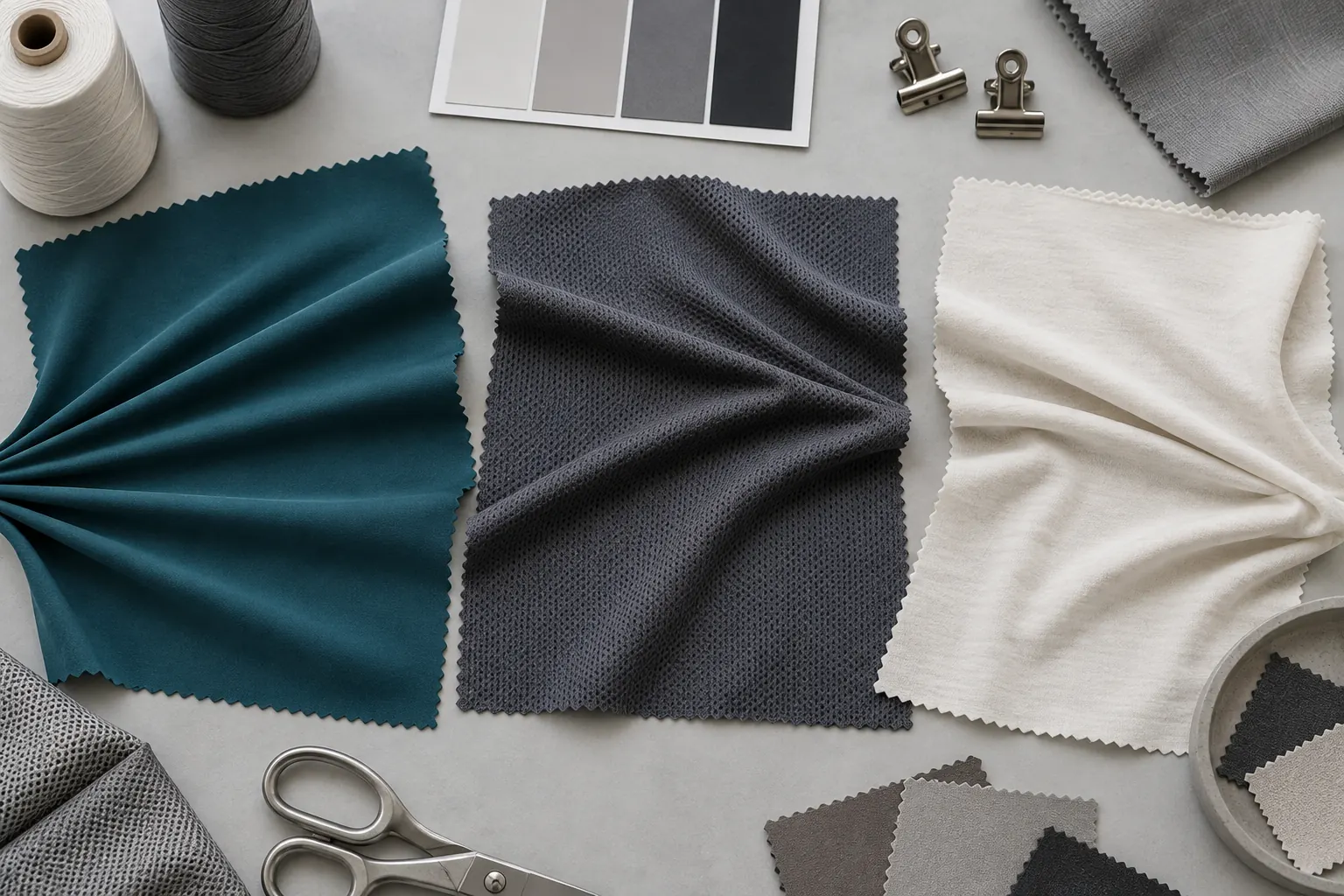
Nylon and spandex
Nylon-spandex fabrics are widely used for leggings, sports bras, fitted shorts, and smooth performance garments. Nylon can provide a soft hand feel and strong abrasion resistance, while spandex supplies stretch and recovery.
The final result depends on the nylon yarn, construction, weight, and finish. A nylon-spandex blend can be engineered for a soft brushed feel, a cool smooth surface, or firmer compression.
Polyester and spandex
Polyester-spandex fabrics are common in training tops, running apparel, teamwear, and printed performance products. Polyester offers good dimensional stability, fast drying, and compatibility with sublimation printing. Spandex adds mobility and shape retention.
These fabrics are useful when color performance, printing, and moisture management are priorities, but the desired hand feel and recovery still need to be tested.
Cotton and spandex
Cotton-spandex fabrics combine the familiar feel of cotton with added flexibility. They are often used for casual activewear, fitted T-shirts, joggers, and lifestyle products.
Cotton can absorb more moisture and dry more slowly than synthetic base fibres, so it may be less suitable for high-sweat performance products unless the product concept prioritizes natural hand feel over rapid drying.
How Spandex Performs in Real Sportswear Scenarios
The correct stretch fabric depends on what the wearer will do in the garment. Movement pattern, support level, climate, contact with equipment, washing frequency, and expected product life all change the specification.
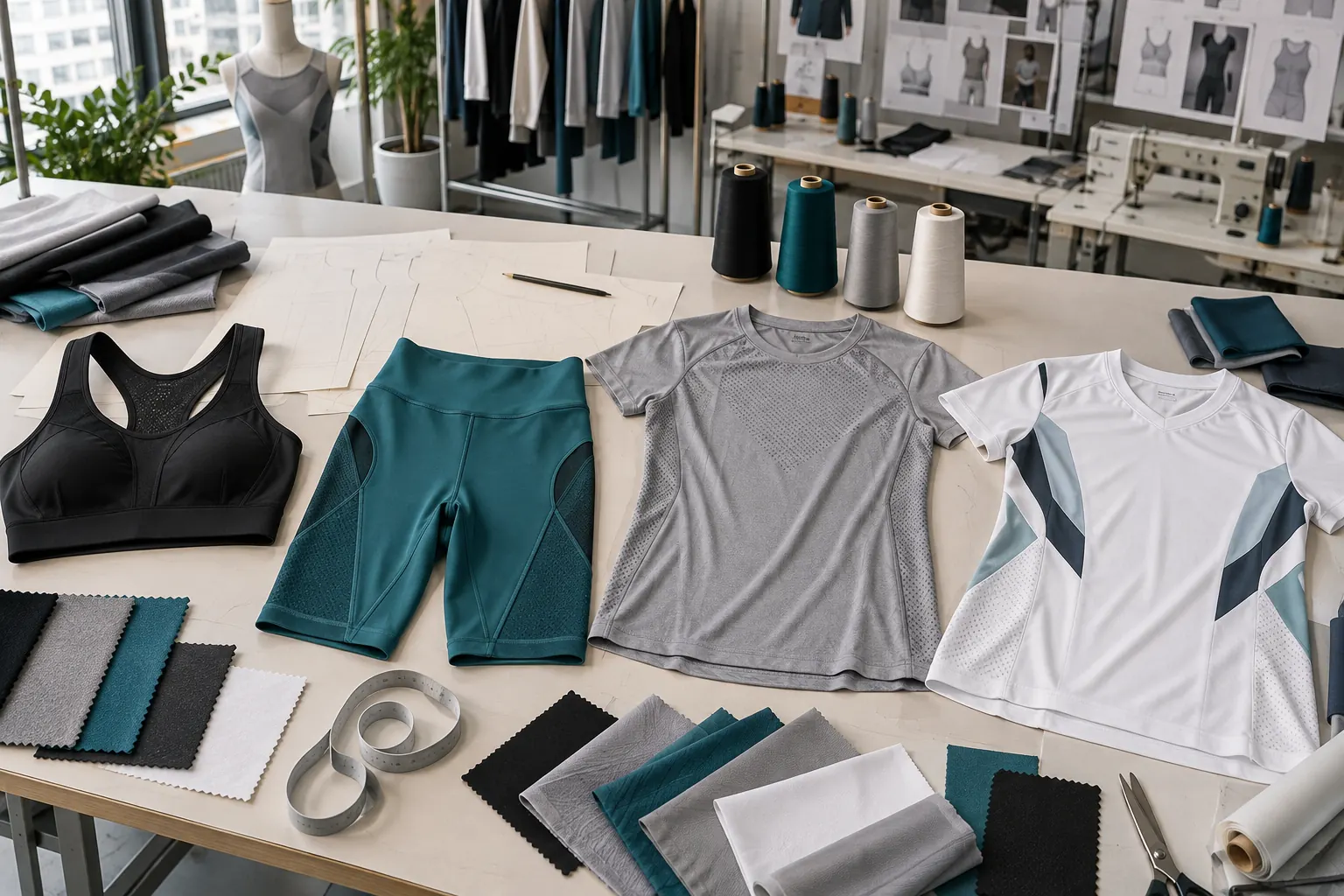
| Use scenario | Common fabric direction | What spandex contributes | Critical checks |
|---|---|---|---|
| Yoga and Pilates leggings | Nylon-spandex or polyester-spandex knit | Four-way mobility and shape recovery | Squat opacity, waistband recovery, pilling, seam stretch |
| Running apparel | Lightweight polyester-spandex or nylon-spandex | Stride mobility and a stable fit | Drying, chafing, pocket bounce, heat and sweat performance |
| Gym and HIIT wear | Durable nylon-spandex or polyester-spandex | Recovery during repeated high-range movement | Abrasion, seam strength, sweat marks, bagging at knees and seat |
| Compression garments | High-recovery warp knit or firm circular knit | Controlled resistance and body support | Modulus, pressure consistency, comfort, recovery after washing |
| Sports bras | Supportive nylon-spandex or polyester-spandex | Stretch for dressing and recovery for support | Underband stability, strap stretch, bounce control, skin comfort |
| Teamwear and printed uniforms | Polyester-spandex performance knit | Mobility without restricting play | Sublimation quality, colorfastness, snagging, dimensional stability |
| Swim and water training | Chlorine-resistant stretch construction | Close fit and freedom of movement | Chlorine exposure, UV exposure, recovery, lining compatibility |
| Athleisure and travel wear | Soft-touch nylon-spandex, cotton-spandex, or brushed knit | Comfort and long-term shape retention | Hand feel, pilling, wrinkle recovery, appearance after washing |
Yoga leggings: stretch is not enough
Yoga leggings move through deep flexion, extension, and rotation. The fabric needs balanced four-way stretch so the garment moves without pulling at the waistband or restricting the knees and hips. The same requirements apply when developing coordinated custom matching yoga sets with leggings, tops, and bras made from one fabric family.
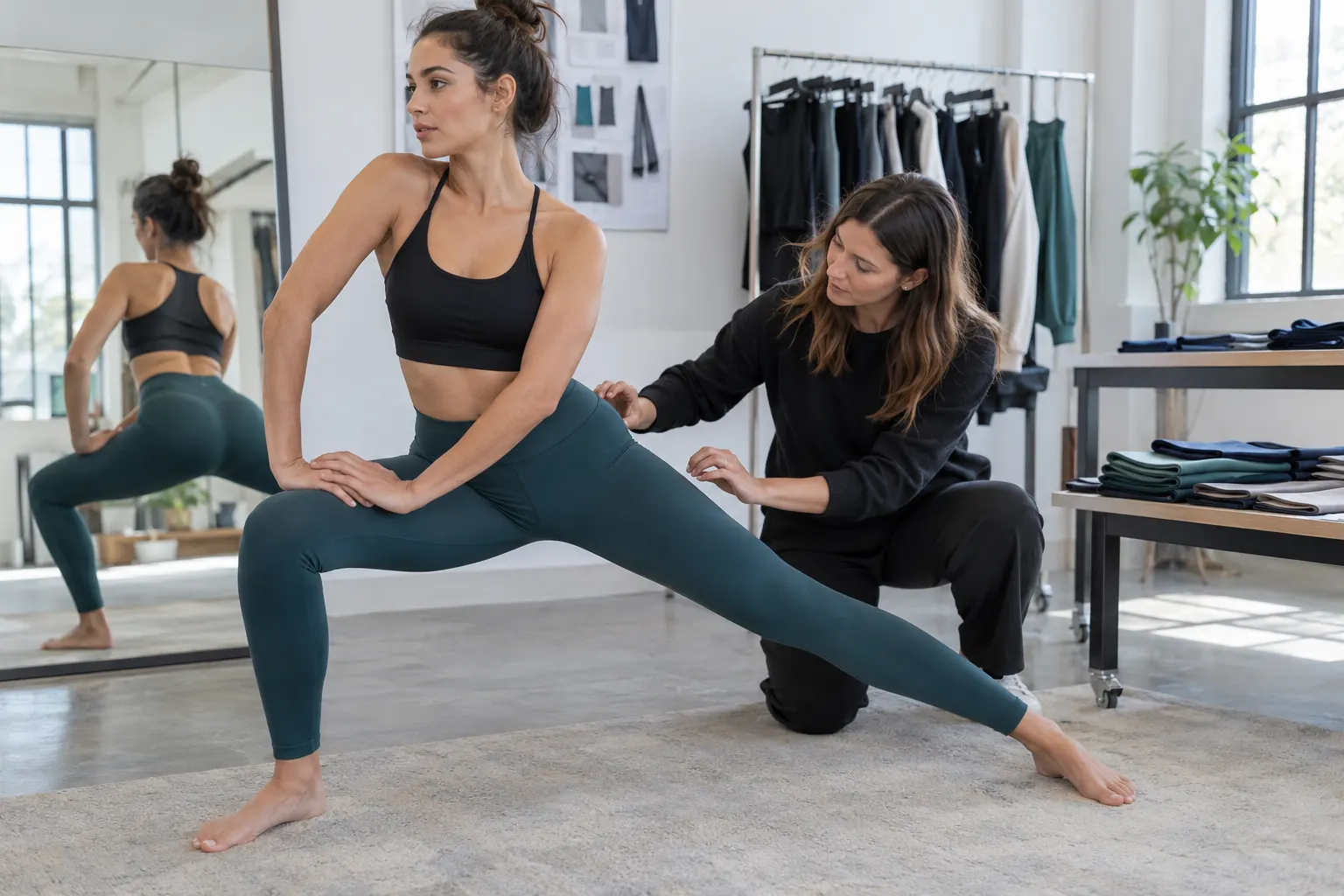
The main risks are transparency under stretch, waistband roll, surface pilling, and permanent growth in the knees or seat. Testing should include dark and light colors because opacity can change by shade. The garment should also be evaluated with the intended seam construction and waistband layers, not only as an unsewn fabric swatch.
Running wear: lightweight stability matters
Running apparel needs mobility, but excessive stretch can allow pockets, waistbands, or hems to move during repeated impact. A suitable running fabric should balance low weight with enough recovery to keep the garment stable.
For running shorts and tights, test sweat visibility, drying rate, inner-thigh abrasion, chafing, and pocket bounce. Reflective transfers and bonded details should also be checked after stretch and washing because the decoration and base fabric need to move together.
Gym and HIIT apparel: repeated movement and abrasion
Strength training and high-intensity workouts combine repeated stretching with contact against benches, mats, bars, and other equipment. The fabric needs recovery, abrasion resistance, and seam security.
Important development checks include bagging at the knees, seat recovery after squats, pilling on contact zones, and seam performance during lunges and overhead movements. A soft brushed surface may feel premium, but it should be tested more carefully where friction is expected.
Compression garments: resistance, not only percentage
Compression products require controlled resistance. Two fabrics with the same spandex percentage may produce very different pressure because knit construction, yarn size, and finishing change the force needed to stretch them. This is especially important in custom fitness and training wear designed for repeated high-intensity use.
Compression shorts, tights, and tops should be evaluated for modulus, pressure consistency, ease of dressing, breathing comfort, and recovery after repeated washing. More spandex does not automatically create better compression.
Sports bras: support changes by panel
A custom sports bra may use several materials in one garment. The main body, underband, power-mesh panel, straps, and lining can each require a different stretch and recovery profile.
The underband needs stability, while the body fabric needs enough stretch for movement and dressing. Testing should include bounce control, strap growth, underband recovery, seam comfort, and changes after washing. The support requirement should be defined by activity level rather than by fibre percentage alone.
Teamwear and sublimated uniforms: print performance matters
Custom team jerseys commonly use polyester-spandex fabrics because polyester works well with sublimation printing and spandex improves movement. The fabric still needs to maintain color, shape, and surface quality through training, competition, and repeated washing.
Before bulk production, check whether printed areas turn pale when stretched, whether heat during sublimation changes recovery, and whether the material snags during contact sports. Panel matching and dimensional stability are especially important for all-over printed designs.
Swimwear and water training: chlorine changes the requirement
Swimwear needs close fit and stretch, but repeated chlorine, sunlight, heat, and sunscreen exposure can damage ordinary elastic fibres. A fabric intended for regular pool use should be specified and tested for that environment.
The development process should evaluate recovery after chlorine exposure, UV stability, lining stretch, opacity when wet, and compatibility between the shell, lining, elastic, and thread. A general activewear fabric should not automatically be approved for swimwear.
How Much Spandex Should Sportswear Contain?
There is no single correct spandex percentage for every product. The appropriate level depends on the garment, base fibre, fabric construction, target fit, and required support.
Indicative development ranges may include:
| Product direction | Common starting range | Main development focus |
|---|---|---|
| Casual stretch tops | 2-8% | Comfort and shape retention |
| Training tops and shorts | 5-15% | Mobility, recovery, and drying |
| Yoga leggings | 10-25% | Four-way stretch, opacity, and recovery |
| Sports bras and compression items | 15-30% | Support, modulus, recovery, and comfort |
These are development references, not fixed specifications. A lower-spandex engineered knit can sometimes outperform a higher-spandex fabric with weak construction or poor heat setting. Physical samples and performance tests should determine the final specification.
How Brands Should Evaluate Spandex Fabrics
When selecting a stretch fabric, brands should review more than composition. A practical evaluation should cover the following factors.
Stretch direction
Confirm whether the material provides two-way or four-way stretch and whether the stretch is balanced in the width and length directions.
Recovery and growth
Test how well the fabric returns after repeated extension. Check high-stress areas such as waistbands, knees, seat panels, underbust bands, and cuffs.
Fabric weight and structure
GSM affects coverage and feel, but it should be considered together with yarn size, knitting density, and surface finish.
Opacity under extension
Legging and compression fabrics should be evaluated while stretched, not only when lying flat. Color, print, and construction can all affect opacity.
Pilling and abrasion resistance
Test surfaces that will experience rubbing from equipment, bags, repeated movement, or washing.
Colorfastness and dimensional stability
Review color transfer, washing performance, shrinkage, and heat sensitivity before approving bulk production.
Hand feel and wearer comfort
Softness, compression, breathability, and surface friction should match the product's use case and target customer.
At Junhao Clothing Manufacturing, fabric selection is part of the OEM and ODM development process. Brands can compare compositions, GSM options, stretch levels, hand feels, and functional finishes before sampling. The approved fabric should then be evaluated together with the pattern, seams, waistband construction, and intended fit.
Advantages and Limitations of Spandex Fibres
Advantages
- Excellent stretch and recovery
- Improved freedom of movement
- Better shape retention in fitted garments
- Useful at relatively low percentages in blends
- Compatible with many sportswear constructions
Limitations
- Performance may decline with excessive heat
- Prolonged chlorine or UV exposure can damage some grades
- Low moisture absorption does not automatically make a fabric breathable
- Blended fabrics can be more difficult to recycle
- Incorrect heat setting or garment construction can reduce recovery
The goal is not to maximize spandex content. It is to choose the right fibre blend and fabric construction for the product's required movement, support, feel, durability, and price point.
Frequently Asked Questions
What is spandex made of?
Spandex is made primarily from a long-chain synthetic polymer containing at least 85% segmented polyurethane. Its soft and hard polymer segments allow it to stretch and recover.
What is spandex made from?
Spandex is generally produced from a macroglycol or polyol, a diisocyanate, and a chain extender. These raw materials react to form the segmented polymer used to make the elastic fibre.
What is spandex fiber?
Spandex fiber is the U.S. term for a manufactured elastic fibre also called elastane. It is usually blended with nylon, polyester, cotton, or other fibres to add stretch and recovery to fabric.
How is spandex produced?
Spandex is produced by forming a prepolymer, extending the polymer chain, preparing a spinning solution, extruding it through a spinneret, solidifying the filaments, applying a finish, and winding the final yarn. Dry spinning is the most widely used commercial process.
What is in spandex?
The fibre-forming material is a segmented polyurethane-based polymer. Commercial spandex may also contain stabilizers, processing aids, and finishes required for production and textile handling.
What is spandex fabric made of?
Most spandex fabric is a blend rather than pure spandex. Common examples include nylon-spandex, polyester-spandex, and cotton-spandex. The label percentage identifies the fibre composition, while the knit or woven construction determines how those fibres form the fabric.
Is spandex the same as elastane?
Yes. Spandex and elastane are generic regional names for the same class of elastic synthetic fibre. LYCRA is a commercial brand name used for particular elastane products.
Does more spandex always mean more stretch?
No. The percentage matters, but yarn type, knit structure, fabric density, finishing, and heat setting also affect stretch and recovery. Fabrics should be tested instead of selected by fibre percentage alone.
Develop the Right Stretch Fabric for Your Sportswear Line
Spandex fibres give activewear its flexibility and recovery, but successful fabric development requires the right balance of composition, construction, weight, finish, and garment design.
Junhao supports custom sportswear development with fabric sourcing, sampling, private labeling, and OEM or ODM production. Share the product type, activity scenario, target climate, fit, preferred hand feel, expected order quantity, and performance requirements through the Junhao Sportswear inquiry form to compare suitable fabric and sampling options.
Technical References
- U.S. Environmental Protection Agency, AP-42, Section 6.9: Synthetic Fibers, including the spandex fibre manufacturing process description: https://www3.epa.gov/ttn/chief/ap42/ch06/final/c06s09.pdf
- American Fiber Manufacturers Association, Spandex Textile Filament Fiber: https://www.fibersource.com/f-tutor/spandex/